What is Age Detection Technology and How it Works


One of the most pressing concerns today is ensuring that age-restricted content, products, and services are only accessed by people who meet the appropriate age criteria. From social media platforms and adult content websites to online gambling platforms, from tobacco and alcohol retailers to streaming services, businesses are looking for reliable ways to verify that users are old enough to access certain content or products.
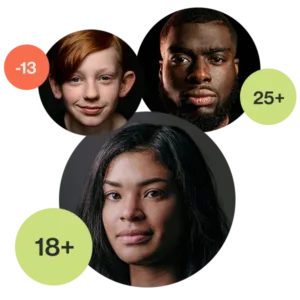
That’s why modern age detection technology has become a key tool for many industries to ensure digital safety and compliance. Age detection includes multiple approaches, from traditional ID checks to Artificial Intelligence (AI). And it’s the latter AI-powered age detection technology that can estimate someone’s age from a simple photo or video stream in mere seconds.
In this article, we will explain what age detection technology is, how it works (especially with AI), what methods exist, and why it’s important for businesses and consumers alike.
What Is Age Detection Technology?
Age detection technology is any system used to estimate or confirm a user’s age before granting access to age-restricted content, products, or services.
Practically speaking, age detection means either estimating someone’s age based on data, for example, analyzing their facial features with AI, or verifying age by checking official documents, like a driver’s license or a passport.
- Age estimation – using AI to „guess” how old you are based on physical traits, like a selfie.
- Age verification – confirming your exact age using a legal document, like a driver’s license.
- Database checks – cross-referencing your name or details against official records, like credit bureaus.
Unlike asking users to input their birthdate, or to answer “Yes/No” to the question „Are you 18?”, or doing a credit card check – modern age detection relies on technology and AI in particular to get a quick, trustworthy answer.
Today, AI-powered age estimation is the preferred alternative to ID checks because of its „low-friction”: you don’t have to go get your documents, as a quick glance at your face (AI facial analysis) is enough. It’s fast, non-intrusive, and works without collecting or storing sensitive identity documents.
Some systems combine multiple methods and come up with a hybrid approach, where a platform may use AI to quickly screen users and only request ID verification when the AI result is uncertain.
How Does Age Detection Technology Work?
Every age detection system follows a similar flow: Data input → Analysis → Age decision. The general flow looks like this:
- Data input: You provide a „signal”: usually a live selfie or a scanned ID document.
- Analysis: The AI scans the signal for specific age-related patterns, with the help of optical character recognition (OCR) or database lookups.
- Age decision: The system outputs a result by outputting an estimated age or age range, for example: „This person is likely 25–30”.
However, today, AI-powered facial analysis has become the most widely used method, especially for age assurance – the process of confirming someone is above or below a certain age threshold without necessarily pinpointing their exact age.
How AI-Based Age Detection Works in Practice
It’s time to take a closer look at how exactly AI figures out a person’s age from a photo. There are four main steps of AI age detection:
STEP 1: Image capture
First, the system captures an image of the user’s face. This could be a selfie, or looking at a webcam, smartphone camera, or even an in-store camera at a self-checkout kiosk. At this point, good lighting is important as it helps get clearer images and more accurate results.
STEP 2: Facial feature extraction
Next, the AI identifies and analyzes key facial features by paying attention to things like the distance between a person’s eyes, the depth of facial wrinkles, skin texture, jawline definition, and the proportions of the face. Predictably, these features change as we age. Typically, children have rounder faces, while adults develop more defined bone structure, and older people show characteristic patterns of aging; for example, “crow’s feet” around the eyes. But AI isn’t just looking at one feature, but rather analyzes dozens or even hundreds of data points simultaneously, creating what’s called a „facial feature map”.
STEP 3: Machine Learning inference
At this stage, the machine learning models have been trained on massive datasets consisting of millions of labeled images showing people of verified ages. Through this training, AI learned to recognize patterns that correlate with different age groups. When it analyzes your face, AI compares your feature map against these learned patterns and calculates probabilities.
STEP 4: Age range output
Finally, the system comes up with an age estimate. Importantly, most AI age detection systems don’t claim to know a person’s exact age. Instead, they predict an age range with a confidence level. For example, the system might determine with 95% confidence that you’re between 25 and 35 years old.
However, for age assurance purposes, this is often enough. If a website needs to confirm you’re over 18, and the AI determines you’re likely between 25 and 35, you’re cleared. If it estimates 14 to 18, you might be asked for additional verification.
EXAMPLE: Imagine you’re trying to access a gambling website that requires users to be 21 or older. You enable your camera for a quick face scan. The AI captures your image, analyzes your facial features, and determines you’re likely between 28 and 36. Within two seconds, you’re granted access with no ID upload required.
Main Age Detection Methods
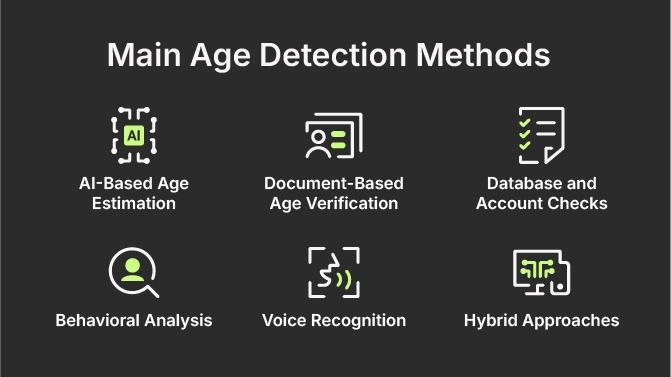
Depending on the use case, organizations might use one or a combination of several age detection methods.
AI-Based Age Estimation
This method uses computer vision and machine learning algorithms to predict age from facial images. Typically done in under 3 seconds, AI age detection doesn’t require document uploads, and creates minimal user friction. However, it provides probabilistic estimates rather than definitive proof of age.
Often, the AI method is preferred because of low-friction age checks, it’s fast, privacy-friendly, and non-intrusive. Users don’t have to dig out their wallets, worry about document security, or wait for manual review.
This method is best for: quick age checks on websites, social media platforms, retail self-checkout systems, and situations where you need to verify someone is above or below an age threshold.
Document-Based Age Verification
This one is a traditional method that requires users to upload photos of government-issued IDs, which are then verified for authenticity and checked for birth date information. It provides definitive proof of age and can confirm exact birth dates when needed. However, document verification requires users to share sensitive documents, takes longer (often 30 seconds to several minutes), and raises more privacy concerns.
This method is best for: high-stakes age verification, like opening financial accounts, legal services, situations requiring exact age confirmation, or regulatory environments that specifically mandate ID checks.
Database and Account Checks
Some systems verify age by cross-referencing user information (name, address, date of birth) against trusted databases like credit bureaus or public records.
For example, a service might verify age by doing a credit card check, assuming that minors typically don’t own a credit card, or using the card info to verify identity. In some countries, the system uses a government or telecom database – the online services where entering something like a national ID number or using a bank’s digital identity service can confirm your age.
Typically, a person verifies their age via a „BankID” or “national e-ID”. Another variant is mobile carrier verification, where your phone number is checked against subscriber info to confirm you’re an adult.
This method is best for: account creation flows where users are already providing personal details, subscription services, or situations where photo verification isn’t practical.
Behavioral Analysis
Another approach involves analyzing user behavior to infer age. This could include tracking online activity patterns, language use, and interactions with content. For example, younger users might have different browsing habits or interact with content in ways that differ from adults. Machine learning algorithms can analyze these patterns to make educated guesses about a user’s age.
Voice Recognition
Emerging technologies are also exploring the use of voice analysis to determine age. By analyzing vocal pitch, tone, and speech patterns, AI systems can estimate whether the speaker falls within a certain age range. This technology is still in its infancy but holds promise for applications in customer service and content filtering.
Hybrid Approaches
Many modern systems combine multiple methods for optimal results. For example, a platform might use AI age estimation as the first line of defense, only requesting document verification when the AI result is uncertain.
| Method | How it works | Best for | Privacy level |
| AI-based estimation | Uses computer vision to analyze facial features from a selfie; predicts age in <3 seconds. | Social media, gaming, retail self-checkouts, and „Challenge 25” checks. | High – Anonymous; no ID storage or PII required). |
| Document verification | Scans and validates government-issued IDs (passports, DLs) for authenticity and birth date. | High-stakes compliance like banking, gambling, and legal services. | Medium/Low – Requires sharing and processing sensitive PII. |
| Database & account checks | Cross-references user info (name, address) against credit bureaus, telecom, or „BankID” records. | Subscription services and regions with established digital ID infrastructure. | Medium – Uses existing personal records instead of biometrics. |
| Behavioral analysis | Tracks browsing habits, language use, and interaction patterns to infer age groups. | Silent background monitoring and content filtering for non-intrusive safety. | Low – Involves persistent tracking and profiling of user activity. |
| Voice recognition | Analyzes vocal pitch, tone, and speech patterns to estimate an age range. | Voice assistants, call centers, and audio-only content platforms. | Medium – Uses biometric voice data, which is sensitive. |
| Hybrid approaches | Uses AI estimation first, only escalating to an ID check if the result is „borderline” or uncertain. | Businesses that want a „best of both worlds” approach: speed + total compliance. | High/Variable – Prioritizes privacy unless further proof is needed. |
Applications of Age Detection Technology

Now, let’s review some of the key applications and use cases where age detection technology makes the most impact.
Age-Restricted Content
Age verification regulations apply to websites offering adult content, violent video games, or mature streaming content. Age detection helps ensure that explicit or R-rated content is not accessible to underage viewers on an account. Some streaming platforms ask for age verification when viewing mature content, while others use profile age settings but may incorporate additional verification if they suspect a child is using an adult’s account.
Alcohol, Tobacco and Other Age-restricted Goods
Both physical and online retailers selling age-restricted products, such as alcohol, tobacco, vaping products, cannabis (in regions where legal), or even knives, need reliable verification. The buyers in an online grocery store, you might be prompted to scan your ID during checkout or use an age estimation tool via your webcam. This way, the seller has documented proof that the customer is an adult, mitigating legal liability.
In a retail environment, AI-powered systems (cameras) are now being integrated into self-checkout kiosks. For example, automated systems in Germany have eliminated the need for cashier intervention in 80% of age-restricted transactions in pilot programs. Research also found that over 60% of shoppers opted in to use facial age verification technology when prompted, with over 50% automatically verified as being over 25.
Online Gaming and Gambling
Gaming platforms and online casinos face strict age verification requirements, as the majority of countries have laws prohibiting minors from gambling or playing real-money betting games online. They must ensure players meet minimum age thresholds (typically 18 or 21, depending on jurisdiction) before allowing real-money gambling or access to certain game features. This is typically done via ID checks or electronic databases.
Social Media Platforms
Major social networks, like Instagram, TikTok, YouTube, and Facebook, are increasingly implementing age detection to keep underage children out of their services or to apply extra protections to minors. For instance, Instagram has tested AI age estimation to catch teens who try to misrepresent their age, partnering with tech companies to scan selfies and confirm if a user is over 18.
Digital Identity and Compliance
Financial services, healthcare portals, and government websites often need to verify user age as part of broader identity verification processes. It is one component of the comprehensive Know Your Customer (KYC) and Anti-Money Laundering (AML) compliance programs.
Age detection technology, in this case, often ties into the ID verification process during onboarding: when a user signs up, the platform checks their ID or uses face recognition not just for identity but also logs the birth date to confirm eligibility. Since age detection in compliance settings typically prioritizes accuracy and auditability, they might store proof that age was verified and how, in case regulators come asking.
Privacy and Compliance Requirements
AI age estimation is often more private than showing a physical ID. Any system that processes personal information must comply with privacy regulations like GDPR in Europe, COPPA in the US, CCPA in California, and similar laws worldwide, that demand clear consent, transparent explanations, limited data retention, strong security measures, and user rights to access or delete their data.
AI age estimation has become popular partly because it naturally supports data minimization – a core privacy principle that says you should only collect the minimum data necessary.
Here’s why AI scores well on privacy:
- Data minimization. The system only needs to know „Are they 18+?” Once it says „Yes,” the image is usually deleted instantly.
- No ID storage. Users don’t upload government documents containing names, addresses, birth dates, and ID numbers.
- Lower risk under GDPR. AI-based age estimation can comply by not storing biometric templates and only outputting age ranges.
For example, regulators like Ofcom in the UK are now mandating „highly effective” age assurance, and AI-based estimation is leading the charge as a privacy-first solution.
So, companies using age verification tools must build privacy and compliance in from the start, which means:
- Collecting only what is necessary.
- Encrypting and quickly deleting ID data.
- Following all regulations to the letter. Maintaining user trust is the bottom line, because without it, people will see the process as an intrusive data grab.
Accuracy and Limitations of Age Detection Technology
So, how accurate is AI age detection?In fact,modern AI age detection systems have become impressively accurate. A study proved that the absolute error margin for AI algorithms has decreased from 4.3 to 3.1 years over the past decade, so leading systems typically achieve:
- Exact age accuracy within ±3-5 years for roughly 70-80% of cases.
- Age threshold accuracy of 90-95%+, when determining if someone is above or below a specific age.
The second metric matters more for most applications. If a system needs to confirm you’re over 18, and you’re actually 28, it doesn’t matter whether it estimates you as 26 or 31– either way, you’re clearly above the threshold.
Of course, no age detection method is 100% foolproof. There are several factors that may affect how well age detection works.
For example, better lighting, higher resolution, and clearer images produce more accurate results. Also, certain age groups (middle-aged adults in particular) tend to yield better results than children or very elderly individuals. Moreover, earlier AI systems showed accuracy variations across different ethnicities and genders. Responsible developers now train on diverse datasets to minimize these biases. Finally, advanced age detection systems include liveness detection to ensure they’re analyzing a real, present person.
It’s important to stress that AI age detection technology produces probabilistic estimates. Basically, it’s like saying „there’s a 90% chance this person is between 22 and 30”. And that’s a good thing, as by providing confidence scores, the system can flag uncertain cases for additional verification.
Here are some limitations to consider:
- Not legally binding. AI estimates typically can’t replace official ID verification for legal purposes.
- Doesn’t prevent determined fraud. Someone could potentially use an older person’s photo.
- Privacy considerations. Facial analysis involves processing biometric data.
- Requires clear images. Systems can’t work with obscured faces or poor lighting.
The key is matching the technology to the use case. Quick website access? AI works beautifully. Opening a mortgage account? You’ll need traditional ID verification.
The Future of Age Detection Technology
In the future, we can expect age detection technology to become more sophisticated and even less intrusive.
Enhanced AI accuracy
Machine learning models continue to improve as they’re trained on larger, more diverse datasets. AI models show more accurate results across different demographics, enhanced fraud detection, faster processing speeds, and more sophisticated confidence scoring.
Bias reduction and fairness
The industry is responding with more diverse training datasets, fairness testing and auditing, transparent reporting of performance across demographics, and regulatory frameworks requiring bias mitigation.
Better user experience
Age verification is predicted to move on-device, creating „age tokens”, like Apple Pay, that confirm a user is 18+ without uploading images to external servers. This allows for instant, private age checks in apps, websites, and even physical smart checkouts.
Regulatory acceptance
As age detection technology matures, regulators are developing clearer frameworks for its acceptable use. For example, the UK has created certification standards, and the EU is considering age verification requirements for various online services. Future systems will likely undergo audits to gain legal status as valid alternatives to physical passports or IDs, building public trust through transparency.
Multi-modal approaches
The future likely involves combining multiple verification methods intelligently, i.e. using AI for quick screening, requesting documents only for uncertain cases, remembering verified users, and adapting requirements based on risk level.
Privacy-enhancing technologies
Innovation is making age detection even more privacy-friendly through on-device processing –running AI models directly on users’ phones; zero-knowledge proofs – confirming age requirements without revealing exact ages; and decentralized identity – storing verification results in user-controlled digital wallets.
Ethical guardrails
Future frameworks will prioritize ephemeral data (deleted immediately after use) and strict privacy laws. The goal is to prevent these systems from becoming surveillance tools while giving users control over how their data is shared.
New uses
Beyond simple retail, age AI is likely to expand into VR/gaming by restricting access to virtual casinos or adult spaces; ride-sharing by verifying age for drivers and passengers; and overall continuous age assurance by monitoring social media to ensure children aren’t using adult accounts or being targeted by predators.
Ondato Age Detection Solutions
At Ondato, we understand that effective age detection requires balancing accuracy, user experience, compliance, and privacy protection. For that, we’ve developed flexible age verification solutions that support multiple verification approaches.
AI-based age estimation. Our computer vision technology provides quick, non-intrusive age verification through facial analysis. Users simply take a selfie, and our system determines whether they meet age requirements, typically within 2-3 seconds.
Document verification. For situations requiring definitive age proof, our document verification service validates government-issued IDs from over 200 countries and territories.
Hybrid workflows. We enable intelligent verification flows that use AI estimation as the primary check and escalate to document verification only when needed.
Privacy-first design. All Ondato age detection solutions are built with privacy at their core: GDPR-compliant processing, minimal data retention, strong encryption, transparent processing, and support for data minimization principles.
Flexible integration. Whether you’re running an e-commerce platform, operating a digital content service, or managing age-restricted access of any kind, Ondato’s age detection integrates smoothly through RESTful APIs, pre-built SDKs, customizable user interfaces, and comprehensive documentation.
Wrap-up
Age detection technology has evolved from simple checkboxes to sophisticated systems that can accurately verify age while respecting privacy and maintaining user experience. By moving away from the „I promise I’m 18” checkbox and toward intelligent, data-driven solutions, we’re building a digital world that is safer for kids and more convenient for adults.
Let’s recap several key points worth remembering:
- Facial analysis powered by machine learning has become the go-to solution for many age detection scenarios because it’s fast, accurate for threshold verification, and privacy-friendly.
- The right age detection approach depends on your specific use case, regulatory environment, and risk tolerance.
- Whatever method you choose, careful attention to data protection, transparency, and regulatory requirements is essential.
- Modern age detection can be both effective and privacy-respecting.
- We’re seeing better accuracy, reduced bias, enhanced fraud prevention, and more thoughtful privacy protections as the field matures.
- Age detection exists to serve legitimate purposes: protecting minors, ensuring regulatory compliance, and maintaining appropriate access to age-restricted products and content.
All in all – the future of age detection is smarter, faster, more private, and more fair.
FAQ